If a and C Attempt to Retransmit Again Immediately
This is the third commodity of our series on TCP, roofing all that you lot need to know to troubleshoot performance problems impacting concern disquisitional applications. After because how TCP opens and closes connections, we will at present examine issues that can happen to a connection in progress, specifically network packet loss.
What Causes Network Parcel Loss?
The two most common causes of network packet loss are:
- Layer two (L2) errors
- and network congestion
If a frame becomes errored from point to point on a connection due to cabling problems, duplex problems, or other layer i events, the receiver will make up one's mind that the data is corrupted and drop it. In virtually cases, an error counter volition be incremented on the interface, which helps when locating where the loss occurred.
Traffic congestion tin crusade input/output discards on interface links, especially when translating betwixt link speeds (10Gbps to 1Gbps for case). On these connections, the egress link may not be able to keep up with the amount of ingress traffic, which may result in dropped packets. The sender of the traffic will make up one's mind the loss occurred and retransmit. These are typically labelled equally "discards" on interfaces.
Equally we have seen in this series, TCP is a connection-oriented protocol. Role of the function of establishing a connection is creating the mechanism to track data that has been sent and acknowledge what is received. This mode, TCP can discover if a packet goes missing and resend it accordingly, ensuring reliable transmission of data.
Network packet loss: are we still coping with that today?
Yep. Despite the maturity of network links to 10Gbps and beyond, parcel loss is yet an underlying network event that impacts applications today. To troubleshoot these bug, we first need to understand how packets are dropped, how we tin detect these events, and how we can resolve them.
TCP Retransmissions
Each byte of information sent in a TCP connexion has an associated sequence number. This is indicated on the sequence number field of the TCP header.
When the receiving socket detects an incoming segment of data, it uses the acknowledgement number in the TCP header to indicate receipt. Subsequently sending a parcel of data, the sender will start a retransmission timer of variable length. If it does not receive an acknowledgment earlier the timer expires, the sender volition assume the segment has been lost and volition retransmit it.

The TCP retransmission mechanism ensures that data is reliably sent from stop to stop. If retransmissions are detected in a TCP connexion, it is logical to presume that packet loss has occurred on the network somewhere between client and server.
TCP Duplicate / Selective Acknowledgments
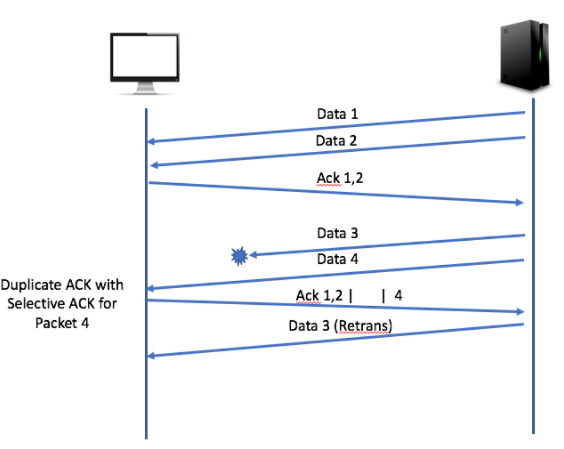
Virtually package analyzers will indicate a duplicate acknowledgment condition when two ACK packets are detected with the same ACK numbers.
How Do These Happen?
Sending TCP sockets usually transmit data in a serial. Rather than sending one segment of data at a fourth dimension and waiting for an acknowledgement, transmitting stations will send several packets in succession. If one of these packets in the stream goes missing, the receiving socket can indicate which bundle was lost using selective acknowledgments.
These allow the receiver to continue to acknowledge incoming data while informing the sender of the missing packet(s) in the stream.
Every bit shown in a higher place, selective acknowledgements will use the ACK number in the TCP header to indicate which packet was lost. At the aforementioned time, in these ACK packets, the receiver can use the SACK option in the TCP header to show which packets have been successfully received after the point of loss.
The SACK pick is a function that is advertised by each station at the beginning of the TCP connection. Most network analyzers will flag these packets as indistinguishable acknowledgements because the ACK number volition stay the same until the missing packet is retransmitted, filling the gap in the sequence.
Typically, indistinguishable acknowledgements mean that one or more packets have been lost in the stream and the connectedness is attempting to recover. They are a mutual symptom of packet loss. In most cases, one time the sender receives three duplicate acknowledgments, it volition immediately retransmit the missing bundle instead of waiting for a timer to expire. These are called fast retransmissions.
Connections with more than latency betwixt client and server will typically take more indistinguishable acknowledgement packets when a segment is lost. In loftier latency connections, it is possible to observe several hundred duplicate acknowledgements for a single lost parcel.
Conclusion
If TCP Retransmissions and duplicate acknowledgments are detected on a connection, don't assume that the sky is falling and performance has come to a screeching halt. Depending on the network betwixt endpoints, a minor amount of them may exist normal.
For example, if a service provider is connecting stop users to applications in a data eye, or if the awarding is hosted in a deject environment, there are several connections that are beyond the control and visibility of the network team. End users may perceive performance every bit normal, but a small number of retransmissions may exist.
However, when troubleshooting an awarding performance problem with incrementing retransmissions for the very users who are complaining, the underlying culprit is likely package loss. Or at least, packet loss will be a pregnant part of the puzzle.
Lost packets crave retransmissions, which have time, which will ho-hum applications down. Depending on how many occur and how fast the endpoints tin recover the missing packets, they tin significantly bear on application performance.
In these cases, walk the link between customer and server, analyzing link-level errors for all infrastructure devices you lot control. It may be that you discover the faulty cable, Frame Check Sequence counter (FCS), or discard indicator that is contributing to the package loss.
Source: https://accedian.com/blog/network-packet-loss-retransmissions-and-duplicate-acknowledgements/
0 Response to "If a and C Attempt to Retransmit Again Immediately"
Post a Comment