what are the four main steps to becoming certified organic
The National Organic Program (run by the USDA) is in charge of labeling foods organic. In order for a nutrient to be labeled "organic" it must run across the USDA'due south organic standards.

Organic vegetables at a farmers' market in Argentine republic
Organic certification is a certification procedure for producers of organic nutrient and other organic agricultural products, in the European Spousal relationship more than commonly known equally ecological or biological products.[1] In general, any business straight involved in food production tin exist certified, including seed suppliers, farmers, food processors, retailers and restaurants. A lesser known counterpart is certification for organic textiles (or organic clothing) that includes certification of textile products fabricated from organically grown fibres.
Requirements vary from country to land (List of countries with organic agriculture regulation), and generally involve a set of production standards for growing, storage, processing, packaging and aircraft that include:
- avoidance of synthetic chemical inputs (e.g. fertilizer, pesticides, antibiotics, food additives), irradiation, and the use of sewage sludge;[2]
- avoidance of genetically modified seed;
- use of farmland that has been gratuitous from prohibited chemical inputs for a number of years (often, three or more than);
- for livestock, adhering to specific requirements for feed, housing, and breeding;
- keeping detailed written production and sales records (audit trail);
- maintaining strict physical separation of organic products from non-certified products;
- undergoing periodic on-site inspections.
In some countries, certification is overseen past the government, and commercial use of the term organic is legally restricted. Certified organic producers are also subject to the same agricultural, food safety and other government regulations that apply to not-certified producers.
Certified organic foods are not necessarily pesticide-gratis, every bit certain pesticides are allowed.[three]
Purpose [edit]
Organic certification addresses a growing worldwide demand for organic food. It is intended to assure quality and prevent fraud, and to promote commerce. While such certification was not necessary in the early days of the organic movement, when small farmers would sell their produce directly at farmers' markets, equally organics accept grown in popularity, more and more than consumers are purchasing organic food through traditional channels, such as supermarkets. Every bit such, consumers must rely on third-party regulatory certification.
For organic producers, certification identifies suppliers of products canonical for employ in certified operations. For consumers, "certified organic" serves equally a production assurance, like to "low fat", "100% whole wheat", or "no bogus preservatives".
Certification is essentially aimed at regulating and facilitating the sale of organic products to consumers. Private certification bodies have their own service marks, which can act every bit branding to consumers—a certifier may promote the loftier consumer recognition value of its logo as a marketing reward to producers.
Methods [edit]
Third-party [edit]
In third party certification, the subcontract or the processing of the agriculture produce is certified in accordance with national or international organic standards past an accredited organic certification agency. To certify a farm, the farmer is typically required to engage in a number of new activities, in improver to normal farming operations:
- Written report the organic standards, which cover in specific particular what is and is non allowed for every aspect of farming, including storage, send and sale.
- Compliance — farm facilities and production methods must comply with the standards, which may involve modifying facilities, sourcing and irresolute suppliers, etc.
- Documentation — extensive paperwork is required, detailing farm history and current set-upwardly, and usually including results of soil and water tests.
- Planning — a written almanac production plan must exist submitted, detailing everything from seed to sale: seed sources, field and crop locations, fertilization and pest control activities, harvest methods, storage locations, etc.
- Inspection — annual on-farm inspections are required, with a physical tour, exam of records, and an oral interview. The vast bulk of the inspections are pre-scheduled visits.
- Fee — an almanac inspection/certification fee (currently starting at $400–$two,000/year, in the US and Canada, depending on the agency and the size of the performance). There are financial assistance programs for qualifying certified operations.[iv]
- Record-keeping — written, 24-hour interval-to-solar day farming and marketing records, covering all activities, must exist available for inspection at whatever fourth dimension.
In addition, short-detect or surprise inspections tin can be made, and specific tests (e.g. soil, water, plant tissue) may be requested.
For first-time farm certification, the soil must meet bones requirements of being free from use of prohibited substances (synthetic chemicals, etc.) for a number of years. A conventional farm must attach to organic standards for this flow, often ii to three years. This is known as being in transition. Transitional crops are not considered fully organic.
Certification for operations other than farms follows a similar process. The focus is on the quality of ingredients and other inputs, and processing and handling conditions. A transport company would exist required to detail the utilize and maintenance of its vehicles, storage facilities, containers, and so forth. A restaurant would have its premises inspected and its suppliers verified as certified organic.
Participatory [edit]
Participatory Guarantee Systems (PGS) represent an culling to third party certification,[v] especially adjusted to local markets and curt supply bondage. They can besides complement tertiary party certification with a private label that brings additional guarantees and transparency. PGS enable the direct participation of producers, consumers and other stakeholders in:
- the option and definition of the standards
- the development and implementation of certification procedures
- the certification decisions
Participatory Guarantee Systems are also referred to as "participatory certification".[6]
Culling certification options [edit]
The word organic is central to the certification (and organic nutrient marketing) procedure, and this is also questioned by some. Where organic laws be, producers cannot use the term legally without certification. To bypass this legal requirement for certification, various alternative certification approaches, using currently undefined terms similar "authentic" and "natural", are emerging. In the Us, motivated by the cost and legal requirements of certification (as of Oct. 2002), the private farmer-to-farmer association, Certified Naturally Grown, offers a "not-profit alternative eco-labelling program for modest farms that grow using USDA Organic methods just are not a part of the USDA Certified Organic program."[7]
In the United kingdom of great britain and northern ireland, the interests of smaller-calibration growers who use "natural" growing methods are represented by the Wholesome Nutrient Association, which issues a symbol based largely on trust and peer-to-peer inspection.
Organic certification and the Millennium Development Goals (MDGs) [edit]
Organic certification, as well every bit fair trade certification, has the potential to straight and indirectly contribute to the achievement of some of the Millennium Development Goals (MDGs), which are the 8 international development goals that were established following the Millennium Summit of the United Nations in 2000, with all Un member states committed to assistance reach the MDGs past 2015. With the growth of upstanding consumerism in adult countries, imports of eco-friendly and socially certified produce from the poor in developing countries have increased, which could contribute towards the achievement of the MDGs. A study by Setboonsarng (2008) reveals that organic certification substantially contributes to MDG1 (poverty and hunger) and MDG7 (environmental sustainability) by way of premium prices and amend market access, among others. This report concludes that for this market-based development scheme to broaden its poverty impacts, public sector support in harmonizing standards, edifice up the chapters of certifiers, developing infrastructure development, and innovating alternative certification systems will be required.[8]
International food standards [edit]
The trunk Codex Alimentarius of the Food and Agriculture System of the United nations was established in November 1961. The Committee's main goals are to protect the wellness of consumers and ensure fair practices in the international food merchandise. The Codex Alimentarius is recognized by the World Trade System equally an international reference bespeak for the resolution of disputes concerning nutrient safety and consumer protection.[9] [10] One of their goals is to provide proper food labelling (full general standard, guidelines on diet labelling, guidelines on labelling claims).
National variations [edit]
| Organic Certification Labels |
|---|
| Kenya - Also East Africa Region |
 Argentine republic |
 Australia |
 Australia |
 Canada |
 European Union |
 France |
 Deutschland |
 Japan |
 United States |
In some countries, organic standards are formulated and overseen by the government. The United States, the European Spousal relationship, Canada and Japan have comprehensive organic legislation, and the term "organic" may be used only by certified producers. Being able to put the word "organic" on a food product is a valuable marketing advantage in today's consumer market place, but does not guarantee the production is legitimately organic. Certification is intended to protect consumers from misuse of the term, and make buying organics easy. Still, the organic labeling made possible by certification itself unremarkably requires caption. In countries without organic laws, authorities guidelines may or may non exist, while certification is handled past non-turn a profit organizations and private companies.
Internationally, equivalency negotiations are underway, and some agreements are already in place, to harmonize certification between countries, facilitating international trade. There are as well international certification bodies, including members of the International Federation of Organic Agriculture Movements (IFOAM) working on harmonization efforts. Where formal agreements do not exist between countries, organic production for export is often certified by agencies from the importing countries, who may establish permanent foreign offices for this purpose. In 2011 IFOAM introduced a new plan - the IFOAM Family of Standards - that attempts to simplify harmonization. The vision is to constitute the apply of i single global reference (the COROS) to admission the quality of standards rather than focusing on bilateral agreements.[11]
The Certcost was a enquiry projection that conducted enquiry and prepared reports about the certification of organic food.[12] The projection was supported by the European Commission and was active from 2008-2011. The website will be bachelor until 2016.[13]
North America [edit]
United States [edit]
In the United States, "organic" is a labeling term for food or agronomical products ("nutrient, feed or fiber") that take been produced according to USDA organic regulations, which ascertain standards that "integrate cultural, biological, and mechanical practices that foster cycling of resource, promote ecological balance, and conserve biodiversity." USDA standards recognize four types of organic product:
- Crops: "Plants that are grown to be harvested every bit food, livestock feed, or cobweb used to add nutrients to the field."
- Livestock: "Animals that tin be used in the production of food, fiber, or feed."
- Processed/multi-ingredient products: "Items that have been handled and packaged (due east.g. chopped carrots) or combined, processed, and packaged (e.g. bread or soup)."
- Wild crops: "Plants from a growing site that is not cultivated."
Organic agricultural operations should ultimately maintain or better soil and water quality, and conserve wetlands, woodlands, and wild animals.[fourteen]
In the U.S., the Organic Foods Production Act of 1990 "requires the Secretary of Agriculture to institute a National Listing of Allowed and Prohibited Substances which identifies synthetic substances that may be used, and the non- synthetic substances that cannot be used, in organic production and handling operations."[fifteen]
Also in the U.S., the Secretary of Agriculture promulgated regulations establishing the National Organic Program (NOP). The final dominion was published in the Federal Register in 2000.
USDA Organic certification confirms that the subcontract or handling facility (whether within the United States or internationally) complies with USDA organic regulations. Farms or handling facilities can be certified past individual, foreign, or State entities, whose agents are accredited by the USDA (accredited agents are listed on the USDA website). Any subcontract or business that grosses more than $5,000 annually in organic sales must be certified. Farms and businesses that brand less than $five,000 annually are "exempt," and must follow all the requirements every bit stated in the USDA regulations except for ii requirements:
- Exempt operations do non need to exist certified to "sell, characterization, or represent" their products equally organic, but may not apply the USDA organic seal or label their products as "certified organic." Exempt operations may pursue optional certification if they wish to utilise the USDA organic seal.
- Exempt operations are not required to accept a arrangement plan that documents the specific practices and substances used in the product or treatment of their organic products
Exempt operations are also barred from selling their products every bit ingredients for use in another producer or handler's certified organic product, and may exist required past buyers to sign an affidavit affirming adherence to USDA organic regulations.[14]
Before an functioning may sell, characterization or represent their products as "organic" (or use the USDA organic seal), information technology must undergo a iii-year transition period where any land used to produce raw organic bolt must be left untreated with prohibited substances.[sixteen]
Operations seeking certification must beginning submit an application for organic certification to a USDA-accredited certifying agent including the following:[fourteen]
- A detailed description of the operation seeking certification
- A history of substances used on the land over the prior 3 years
- A list of the organic products grown, raised, or processed
- A written "Organic System Plan (OSP)" which outlines the practices and substances intended for use during futurity organic production.
- Processors/handlers who are not primarily a farm (and farms with livestock and/or crops that also process products) must consummate an Organic Treatment Plan (OHP), and also include a production profile and characterization for each product
Certifying agents then review the application to confirm that the operation'due south practices follow USDA regulations, and schedule an inspection to verify adherence to the OSP, maintenance of records, and overall regulatory compliance[xvi]
Inspection During the site visit, the inspector observes onsite practices and compares them to the OSP, looks for whatsoever potential contamination by prohibited materials (or any risk of potential contamination), and takes soil, tissue, or production samples every bit needed. At farming operations, the inspector will also examine the fields, water systems, storage areas, and equipment, assess pest and weed management, check feed production, purchase records, livestock and their living conditions, and records of animal health management practices. For processing and treatment facilities, the inspector evaluates the receiving, processing, and storage areas for organic ingredients and finished products, every bit well equally assessing any potential hazards or contamination points (from "sanitation systems, pest direction materials, or nonorganic processing aids"). If the facility also processes or handles nonorganic materials, the inspector will also clarify the measures in place to preclude commingling.[14]
If the written awarding and operational inspection are successful, the certifying amanuensis will effect an organic certificate to the applicant. The producer or handler must so submit an updated application and OSP, pay recertification fees to the agent, and undergo annual onsite inspections to receive recertification annually. One time certified, producers and handlers can take upward to 75% of their organic certification costs reimbursed through the USDA Organic Certification Cost-Share Programs.[14]
Federal legislation defines three levels of organic foods.[17] Products made entirely with certified organic ingredients, methods, and processing aids can exist labeled "100% organic" (including raw agricultural commodities that have been certified), while only products with at least 95% organic ingredients may exist labeled "organic" (any non-organic ingredients used must autumn under the exemptions of the National List). Under these two categories, no nonorganic agricultural ingredients are allowed when organic ingredients are available. Both of these categories may likewise brandish the "USDA Organic" seal, and must state the proper noun of the certifying amanuensis on the information panel.[eighteen]
A third category, containing a minimum of seventy% organic ingredients, tin be labeled "made with organic ingredients," but may not display the USDA Organic seal. Any remaining agricultural ingredients must be produced without excluded methods, including genetic modification, irradiation, or the application of synthetic fertilizers, sewage sludge, or biosolids. Non-agricultural ingredients used must be allowed on the National List. Organic ingredients must be marked in the ingredients list (e.g., "organic dill" or with an asterisk cogent organic condition).[18] In addition, products may also display the logo of the certification torso that approved them.[19]
Products made with less than 70% organic ingredients can not be advertised every bit "organic," but can list individual ingredients that are organic as such in the product's ingredient statement. Also, USDA ingredients from plants cannot be genetically modified.[xix]
Livestock feed is just eligible for labeling as "100% Organic" or "Organic."[16]
Alcoholic products are also bailiwick to the Alcohol and Tobacco Tax and Trade Bureau regulations. Any employ of added sulfites in vino made with organic grapes means that the production is only eligible for the "made with" labeling category and therefore may not apply the USDA organic seal. Wine labeled every bit fabricated with other organic fruit cannot have sulfites added to it.[eighteen]
Organic textiles made be labeled organic and use the USDA organic seal if the finished production is certified organic and produced in full compliance with USDA organic regulations. If all of a specific fiber used in a product is certified organic, the label may state the per centum of organic fibers and identify the organic material.[18]
Organic certification mandates that the certifying inspector must be able to complete both "trace-dorsum" and "mass balance audits" for all ingredients and products. A trace-back audit confirms the being of a record trail from time of purchase/product through the final sale. A mass residue audit verifies that plenty organic product and ingredients have been produced or purchased to match the amount of product sold. Each ingredient and product must accept an assigned lot number to ensure the existence of a proper audit trail.[18]
Some of the primeval organizations to carry out organic certification in North America were the California Certified Organic Farmers, founded in 1973, and the voluntary standards and certification program popularized past the Rodale Press in 1972.[20] Some retailers have their stores certified equally organic handlers and processors to ensure organic compliance is maintained throughout the supply chain until delivered to consumers, such equally Vitamin Cottage Natural Grocers, a 60-twelvemonth-old concatenation based in Colorado.
Violations of USDA Organic regulations behave fines up to $11,000 per violation, and tin also lead to suspension or revocation of a subcontract or business'due south organic certificate.[xiv]
Once certified, USDA organic products tin be exported to countries currently engaged in organic trade agreements with the U.Due south., including Canada, the Eu, Japan, and Taiwan, and do non crave additional certification every bit long as the terms of the agreement are met.[14]
In the The states the situation is undergoing its own FDA Food Safe Modernization Deed.
Canada [edit]
In Canada, certification was implemented at the federal level on June 30, 2009. Mandatory certification is required for agricultural products represented as organic in import, export and inter-provincial merchandise, or that bear the federal organic logo.[21] In Quebec, provincial legislation provides government oversight of organic certification within the province, through the Quebec Accreditation Board (Conseil D'Accréditation Du Québec). Only products that use at least 95% organic materials in production are allowed to bear the Canadian organic logo. Products betwixt 70-95% may declare they have twenty% of organic ingredients, however they do not meet requirements to bear the certified logo.[22] Transitioning from a conventional agricultural operation to an organic operation takes the producers upward to three years to receive organic certification, during which time products cannot be marketed as organic products, and producers volition non receive pricing premiums on their goods during this time.[23] Cows, sheep, and goats are the simply livestock that are allowed to be transitioned to organic, under Canada's regulations. They must undergo organic direction for one twelvemonth earlier their products tin can exist considered certified organic.[24]
South America [edit]
Argentine republic [edit]
In Argentina, the Organic certification was implemented in Dec 2012, through a Ministry of Agriculture resolution.[25] Organic products are labeled with the Orgánico Argentina seal, which is administered by SENASA and issued by four private companies.[26] [27] [28] Organic production is regulated by the 25.127 Act, passed in 1999.[29]
During 2019, seventy,446 hectares (174,080 acres) of land were used for organic production certified with the Argentine seal.[30]
Europe [edit]
Public organic certification [edit]
EU countries acquired comprehensive organic legislation with the implementation of the EU-Eco-regulation 1992. Supervision of certification bodies is handled on the national level. In March 2002 the European Commission issued an EU-wide label for organic food. It has been mandatory throughout the European union since July 2010.[31] and has become compulsory after a two-year transition menstruum.[32]
In 2009 a new logo was called through a design competition and online public vote.[33] [34] The new logo is a green rectangle that shows twelve stars (from the European flag) placed such that they class the shape of a foliage in the wind. Unlike earlier labels no words are presented on the label lifting the requirement for translations referring to organic nutrient certification.[35]
The new EU organic label has been implemented since July 2010 and has replaced the old European Organic label. Even so, producers that take had already printed and ready to use packaging with the old label were immune to use them in the upcoming ii years.[36]
The development of the Eu organic characterization was develop based on Denmark's organic food policy and the rules backside the Danish organic nutrient label which at the moment holds the highest rate of recognition amidst its users in the world respectively 98% and xc% trust the label. The current EU organic label is meant to signal to the consumer that at least 95% of the ingredients used in the candy organic food is from organic origin and 5% considered an acceptable error margin.[37]
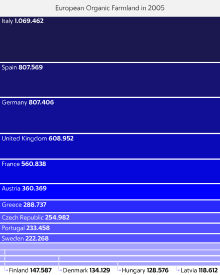
European Organic Farmland in 2005
| Land | Area (ha) | Percent (%) |
|---|---|---|
| Austria | 360,369 | 11 |
| Kingdom of belgium | 22,994 | i.7 |
| Cyprus | 2 | one.1 |
| Czechia | 254,982 | 7.two |
| Kingdom of denmark | 134,129 | five.two |
| Republic of finland | 147,587 | half dozen.5 |
| French republic | 560,838 | 2 |
| Germany | 807,406 | iv.7 |
| Greece | 288,737 | 7.2 |
| Hungary | 128,576 | two |
| Republic of ireland | 34,912 | 0.8 |
| Italy | 1,069,462 | 8.4 |
| Latvia | 118,612 | seven |
| Republic of lithuania | 64,544 | ii.three |
| Grand duchy of luxembourg | 3,158 * | 2.4 |
| Malta | 14 | 0.1 |
| Netherlands | 48,765 | 2.5 |
| Poland | 82,730 * | 2.4 |
| Portugal | 233,458 | 6.3 |
| Slovakia | 90,206 | four.8 |
| Slovenia | 23,499 | 4.8 |
| Kingdom of spain | 807,569 | 3.2 |
| Sweden | 222,268 | vi.ii |
| Switzerland | 11 | |
| United Kingdom | 608,952 | 3.8 |
| EU Total | 6,115,465 | iii.ix |
| Source: "Eurostat press release 80/2007" | ||
Private organic certification [edit]
As well the public organic certification regulation Eu-Eco-regulation in 1992, there are various private organic certifications bachelor:
- Demeter International is the largest certification organization for biodynamic agriculture, and is one of three predominant organic certifiers.[38] Demeter Biodynamic Certification is used in over fifty countries to verify that biodynamic products meet international standards in production and processing.[39] The Demeter certification program was established in 1928, and as such was the first ecological label for organically produced foods.[40]
- Bio Suisse established in 1981 is the Swiss organic farmer umbrella organization. International activities are mainly focused on imports towards Switzerland and don't support export activities.
- Global Organic Textile Standard (GOTS) is a individual standard for Organic wear for the entire post-harvest processing (including spinning, knitting, weaving, dyeing and manufacturing) of wearing apparel and home textiles made with organic fibres (such as organic cotton fiber, organic wool etc.). It includes both environmental and social criteria. Established in 2002, the standard is used in over 68 countries[41] and is endorsed past USDA[42] and IFOAM - Organics International.[43] The material must be at least 95% organic, every bit certified past "recognized international or national standards." If the material is seventy% organic, it can exist labeled equally "made with organic".[44]
Czech Commonwealth [edit]
Following individual bodies certify organic produce: KEZ, o. p. s. (CZ-BIO-001), ABCert, AG (CZ-BIO-002) and BIOCONT CZ, s. r. o. (CZ-BIO-003). These bodies provide decision-making of processes tied with issueing of certificate of origin. Controlling of compliancy (to (ES) no 882/2004 directive) is provided by authorities body ÚKZÚZ (Fundamental Institute for Supervising and Testing in Agriculture).[45]
French republic [edit]
In France, organic certification was introduced in 1985. It has established a green-white logo of "AB - agriculture biologique." The certification for the AB label fulfills the European union regulations for organic nutrient. The certification process is overseen by a public institute ("Agence française cascade le développement et la promotion de fifty'agriculture biologique" unremarkably shortened to "Agence bio") established in November 2001. The bodily certification authorities include a number of dissimilar institutes similar Aclave, Agrocert, COSMEBIO, Ecocert SA, Qualité France SA, Ulase, SGS ICS.
Frg [edit]
In Frg the national label was introduced in September 2001 following in the footsteps of the political campaign of "Agrarwende" (agricultural major shift) led by minister Renate Künast of the Greens party. This campaign was started afterward the outbreak of mad-moo-cow affliction in 2000. The furnishings on farming are still challenged by other political parties. The national "Bio"-label in its hexagon green-black-white shape has gained broad popularity - in 2007 there were 2431 companies having certified 41708 products. The popularity of the label is extending to neighbouring countries similar Austria, Switzerland and France.
In the German-speaking countries at that place take been older non-government organizations that had issued labels for organic food long before the advent of the Eu organic food regulations. Their labels are still used widely every bit they significantly exceed the requirements of the EU regulations. An organic food label similar "demeter" from Demeter International has been in use since 1928[46] and this characterization is still regarded as providing the highest standards for organic food in the world.[ citation needed ] Other active NGOs include Bioland (1971), Biokreis (1979), Biopark (1991), Ecoland (1997), Ecovin (1985), Gäa eastward.V. (1989), Naturland (1981) and Bio Suisse (1981).
Greece [edit]
In Greece, organic certification is available from viii organizations approved by Eu.[47] Most of them are BIOHELLAS and the DIO (Greek: Οργανισμός Ελέγχου και Πιστοποίησης Βιολογικών Προϊόντων - ΔΗΩ)[1]
Ireland [edit]
In Ireland, organic certification is available from the Irish Organic Farmers and Growers Association, Demeter Standards Ltd. and Organic Trust Ltd.
Switzerland [edit]
In Switzerland, products sold as organic must comply at a minimum with the Swiss organic regulation (Regulation 910.18).[48] Higher standards are required before a product can be labelled with the Bio Suisse label.[49]
Sweden [edit]
In Sweden, organic certification is handled by the organisation KRAV (agriculture) with members such as farmers, processors, trade and as well consumer, ecology and fauna welfare interests.[50]
Great britain [edit]
In the United Kingdom, organic certification is handled past a number of organizations, regulated past The Department for Environment, Nutrient and Rural Affairs (DEFRA), of which the largest are the Soil Association and Organic Farmers and Growers. While UK certification bodies are required to encounter the EU minimum organic standards for all member states; they may cull to certify to standards that exceed the minimums, equally is the case with the Soil Association.[51] [52]
The farmland converted to produce certified organic food has seen a pregnant evolution in the EU15 countries, rising from 1.8% in 1998 to 4.i% in 2005. For the current EU25 countries however the statistics study an overall percentage of simply 1.v% as of 2005. However the statistics showed a larger turnover of organic nutrient in some countries, reaching 10% in France and 14% in Germany. In France 21% of available vegetables, fruits, milk and eggs were certified every bit organic. Numbers for 2010 show that 5.iv% of German farmland has been converted to produce certified organic food, as has 10.4% of Swiss farmland and eleven.7% of Austrian farmland.[53] Non-Eu countries have widely adopted the European certification regulations for organic food, to increase export to Eu countries.
Asia and Oceania [edit]
Australia [edit]
In Australia, organic certification is performed by several organisations that are accredited by the Biosecurity[54] section of the Department of Agriculture (Australia), formerly the Australian Quarantine and Inspection Service, under the National Standard for Organic and Biodynamic Produce.[55] All claims virtually the organic condition of products sold in Commonwealth of australia are covered under the Contest and Consumer Act 2010.[56]
In Australia, the Organic Federation of Commonwealth of australia is the acme trunk for the organic industry in Australia[57] and is office of the government's Organic Consultative Commission Legislative Working Group that sets organic standards.[58]
Department of Agriculture accreditation is a legal requirement for all organic products exported from Australia.[55] Export Control (Organic Produce Certification) Orders are used by the Section to assess organic certifying bodies and recognise them as approved certifying organisations. Approved certifying organisations are assessed by the Department for both initial recognition and on an at least almanac ground thereafter to verify compliance.[59]
In the absenteeism of domestic regulation, DOA accreditation too serves as a 'de facto' benchmark for certified production sold on the domestic marketplace.[threescore] Despite its size and growing share of the economy "the organic manufacture in Australia remains largely cocky-governed. There is no specific legislation for domestic organic food standardisation and labelling at the land or federal level as at that place is in the USA and the Eu".[61]
Australian approved certifying organisations [edit]
The Department has several approved certifying organisations that manage the certification process of organic and bio-dynamic operators in Australia. These certifying organisations perform a number of functions on the Department's behalf:[62]
- Assess organic and bio-dynamic operators to determine compliance to the National Standard for Organic and Bio-Dynamic Produce[63] and importing country requirements.
- Issue a Quality Management Certificate (QM Certificate) to organic operators to recognise compliance to consign requirements.
- Issue Organic Produce Certificates (Consign Documentation) for consignments of organic and bio-dynamic produce being exported.
Equally of 2015, there are seven approved certifying organisations:[64]
- AUS-QUAL Pty Ltd (AUSQUAL)
- Australian Certified Organic (ACO)
- Bio-Dynamic Research Institute (BDRI)
- NASAA Certified Organic (NCO)
- Organic Food Chain (OFC)
- Safe Nutrient Production Queensland (SFQ)
- Tasmanian Organic-dynamic Producers (TOP)
There are 2567 certified organic businesses reported in Australia in 2014. They include 1707 master producers, 719 processors and manufacturers, 141 wholesalers and retailers plus other operators.[65]
Australia does not take a national logo or seal to place which products are certified organic, instead the logos of the individual certifying organisations are used.[55] [66]
Red china [edit]
In China, the organic certification is administered by a government agency named Certification and Accreditation Administration of the People's Republic of Red china (CNCA). While the implementation of certification works, including site checking, lab examination on soil, water, product qualities are performed by the China Quality Certification Centre (CQC) which is an agency of Administration of Quality Supervision, Inspection and Quarantine (AQSIQ).The organic certification procedures in china are performed co-ordinate to China Organic Standard GB/T 19630.1-4—2011 which was issued in year 2011. This standard has governed standard procedure for Organic certification process performed by CQC, including awarding, inspection, lab exam procedures, certification decision and post certification administration. The certificate issued past CQC are valid for i yr.
In that location are two logos that are currently used by the CQC for labeling products with Organic Certification, these are the Organic Logo and CQC Logo. No conversion to organic Logo at present.
There were more than 19000 valid certificates and 66 organic certification bodies until 2018 in China.[ citation needed ]
India [edit]
In Republic of india, APEDA regulates the certification of organic products as per National Standards for Organic Production. "The NPOP standards for product and accreditation system have been recognized by European Commission and Switzerland as equivalent to their country standards. Similarly, USDA has recognized NPOP conformity cess procedures of accreditation as equivalent to that of Us. With these recognitions, Indian organic products duly certified past the accredited certification bodies of India are accepted by the importing countries."[67] Organic food products manufactured and exported from India are marked with the Republic of india Organic certification marking issued past the APEDA.[68] APEDA has recognized 11 inspection certification bodies, some of which are branches of strange certification bodies, others are local certification bodies.
Nippon [edit]
In Japan, the Japanese Agricultural Standard (JAS) was fully implemented as law in Apr 2001. This was revised in Nov 2005 and all JAS certifiers were required to be re-accredited past the Ministry of Agronomics.[69]
Singapore [edit]
As of 2014 the Agri-Food & Veterinary Authorisation of Singapore had no organic certification process, merely instead relied on international certification bodies; it does not rails local producers who claim to have gotten organic certification.[70]
Cambodia [edit]
In Kingdom of cambodia, Cambodian Organic Agriculture Association (COrAA) is the only organization that is authorized to requite certificate for organic agricultural products. It is a nationwide private organisation working for the promotion of organic and sustainable agriculture in Kingdom of cambodia. COrAA has developed both organic and chemical-free agronomical standards and provides third-party-certification to producers following these standards. In addition, the services that COrAA provides include technical training for the conversion from chemical/conventional to organic farming, marketing support, organic awareness edifice among the full general public, and a platform for dialogue and cooperation among organic stakeholders in Cambodia.
Africa [edit]
Kenya [edit]
In Kenya, the Kenya Organic Agriculture Network (KOAN) is mandated to coordinate the Organic Sector. It is the national Coordinator and Issuer of the document nether Participatory Guarantee System (PGS). KOAN is also the custodian of the Kilimohai Organic Mark of Organic Certification under the East Africa Organic Products Standards.
Problems [edit]
Organic certification is not without its critics. Some of the staunchest opponents of chemical-based farming and manufactory farming practices also oppose formal certification. They encounter information technology as a fashion to drive independent organic farmers out of business organisation, and to undermine the quality of organic food.[71] Other organizations such equally the Organic Trade Association work within the organic community to foster awareness of legislative and other related problems, and enable the influence and participation of organic proponents.
Obstacles to small contained producers [edit]
Originally, in the 1960s through the 1980s, the organic food industry was equanimous of mainly small, independent farmers, selling locally. Organic "certification" was a matter of trust, based on a direct relationship between farmer and consumer. Critics[72] view regulatory certification as a potential bulwark to entry for minor producers, past burdening them with increased costs,[73] paperwork, and bureaucracy[74]
In China, due to government regulations, international companies wishing to market organic produce must be independently certified. Information technology is reported that "Australian food producers are spending up to $50,000 to exist certified organic by Chinese authorities to crack the burgeoning middle-class market of the Asian superpower."[75] Whilst the certification procedure is described by producers as "extremely difficult and very expensive", a number of organic producers have acknowledged the ultimately positive effect of gaining access to the emerging Chinese market. For example, figures from Australian organic infant formula and baby nutrient producer Bellamy'due south Organic indicate export growth, to Cathay lonely, of 70 per cent per year since gaining Chinese certification in 2008,[75] while like producers accept shown export growth of 20 per cent to 30 per cent a year following certification[76]
Superlative Australian organic certification torso, Australian Certified Organic, has stated nonetheless that "many companies accept baulked at risking the coin because of the circuitous, unwieldy and expensive process to earn Chinese certification."[75] By comparing, equivalent certification costs in Australia are less than $ii,000 (AUD),[77] with costs in the Us equally low as $750 (USD) for a similarly sized business concern.[78]
Manipulative apply of regulations [edit]
Manipulation of certification regulations as a fashion to mislead or outright dupe the public is a very existent business concern. Some examples are creating exceptions (allowing non-organic inputs to be used without loss of certification status) and artistic interpretation of standards to run into the letter of the alphabet, just not the intention, of particular rules. For instance, a complaint filed with the USDA in February 2004 against Bayliss Ranch, a food ingredient producer and its certifying agent, charged that tap h2o had been certified organic, and advertised for use in a variety of water-based torso care and nutrient products, in club to label them "organic" under US law. Steam-distilled plant extracts, consisting mainly of tap h2o introduced during the distilling process, were certified organic, and promoted equally an organic base of operations that could so be used in a claim of organic content. The case was dismissed by the USDA, as the products had been actually used only in personal care products, over which the section at the time extended no labeling command. The company subsequently adjusted its marketing by removing reference to use of the extracts in nutrient products.
In 2013 the Australian Contest and Consumer Committee said that h2o can no longer be labelled as organic water considering, based on organic standards, water cannot exist organic and it is misleading and deceptive to label whatsoever h2o every bit such.[79]
False balls of quality [edit]
The label itself tin can be used to mislead many customers that food labelled as being organic is safer, healthier and more nutritious.[80] [81] [82] [83] [84] [85] [86] Thus, a product may be labelled organic, but take no significant nutritional value compared to other products.
Erosion of standards [edit]
Critics of formal certification besides fear an erosion of organic standards. Provided with a legal framework within which to operate, lobbyists can push button for amendments and exceptions favorable to large-scale product, resulting in "legally organic" products produced in ways similar to current conventional food.[87] Combined with the fact that organic products are at present sold predominantly through high volume distribution channels such equally supermarkets, the concern is that the market place is evolving to favor the biggest producers, and this could result in the small organic farmer being squeezed out.
In the United States large food companies, have "assumed a powerful role in setting the standards for organic foods."[88] Many members of standard-setting boards come up from large nutrient corporations.[88] As more corporate members have joined, many nonorganic substances take been added to the National List of acceptable ingredients.[88] The Usa Congress has besides played a function in allowing exceptions to organic food standards. In December 2005, the 2006 agricultural appropriations beak was passed with a rider allowing 38 synthetic ingredients to be used in organic foods, including food colorings, starches, sausage and hot-dog casings, hops, fish oil, chipotle chili pepper, and gelatin; this allowed Anheuser-Busch in 2007 to take its Wild Hop Lager certified organic "even though [it] uses hops grown with chemical fertilizers and sprayed with pesticides."[89] [90]
Meet too [edit]
- List of countries with organic agronomics regulation
- List of organic food topics
- NSF International
- Organic farming
- Organic article of clothing
- Organic cotton
- Standards of identity for food
- Farm assurance
- Certified Naturally Grown
- Herbicide
- Biopesticide
- Organic nutrient culture
References [edit]
Citations and notes [edit]
- ^ Labelling, article xxx of Regulation (EU) 2018/848 of the European Parliament and of the Council of xxx May 2018 on organic production and labelling of organic products and repealing Council Regulation (EC) No 834/2007.
- ^ "EPA Definition of certified organic".
- ^ "Pestcides in Organic Farming". University of California, Berkeley. Retrieved 2014-06-17 .
Organic foods are not necessarily pesticide-free. Organic foods are produced using only certain pesticides with specific ingredients. Organic pesticides tend to have natural substances like soaps, lime sulfur and hydrogen peroxide as ingredients. Non all natural substances are immune in organic agronomics; some chemicals like arsenic, strychnine and tobacco grit (nicotine sulfate) are prohibited. ...
- ^ "FAQ: Becoming a Certified Operation". United States Section of Agriculture: Agronomical Marketing Service . Retrieved iv November 2014.
- ^ "Participatory Guarantee Systems: 5 Instance Studies" (PDF). IFOAM. Archived from the original (PDF) on 2010-06-21. Retrieved 2010-08-sixteen .
- ^ CAP2020 - Organic Farmin in Brazil - Participatory Certification and Local Markets for Sustainable Agronomical Evolution
- ^ [Certified Naturally Grown]. Retrieved iv-Mar-2006.
- ^ Southward. Setboonsarng. "Can Ethical Merchandise Certification Contribute to the Attainment of the Millennium Development Goals? A Review of Organic and Fair-trade Certification." In Organic Agriculture and Postal service-2015 Development Goals: Building on the Comparative Advantage of Poor Farmers. Ed. Setboonsarng, South. and A. Markandya. pp. 79-103. 2015. Manila: ADB. https://www.adb.org/sites/default/files/publication/161042/organic-agriculture-post-2015-development-goals.pdf.
- ^ Understanding on the Application of Sanitary and Phytosanitary Measures World Merchandise Organization. Accessed 3 September 2008.
- ^ Understanding the Codex Alimentarius Preface. Tertiary Edition. Published in 2006 by the World Health Organization and the Food and Agronomics Arrangement of the United nations. Accessed 3 September 2008.
- ^ "IFOAM Family unit of Standards". IFOAM. Archived from the original on 2012-06-02.
- ^ "FiBL project Economic assay of certification systems for organic food and farming". Inquiry Institute of Organic Agriculture. Retrieved 30 October 2015. [ permanent dead link ]
- ^ "Public project results". CertCost. Archived from the original on 19 Oct 2015. Retrieved xxx October 2015.
- ^ a b c d e f g Baier, Ann; Ahramijian, Lisa. "Organic Certification of Farms and Businesses Producing Agronomical Products". ATTRA - A National Sustainable Agriculture Assistance Plan. National Center for Appropriate Technology. Retrieved 21 Feb 2016.
- ^ Text copied from "National List of Allowed and Prohibited Substances". Agricultural Marketing Service. Retrieved 15 June 2011.
- ^ a b c "Guidelines for Organic Processing and Treatment" (PDF). Maine Organic Farmers and Gardeners Association Certification Services. Maine Organic Farmers and Gardeners Clan. Retrieved 21 February 2016.
- ^ "Labeling organic products". U.Southward. Section of Agronomics. October 2012. Retrieved 3 April 2013.
- ^ a b c d e "Labeling Organic Products" (PDF). United States Department of Agriculture. USDA Agricultural Marketing Service. Retrieved 21 February 2016.
- ^ a b "Organic Agronomics". USDA.
- ^ Parlet, Aubrey (2009). "Organic Foods Production: What Consumers Might Not Know near the Utilise of Synthetic Substances". Loyola Consumer Law Review. 21 (three): 395. Retrieved 21 February 2016.
- ^ Organic Food and Farming Certification Ontario Ministry building of Agriculture, Food and Rural Affairs (OMAFRA). May 1, 2002.
- ^ "FAQs | Canada's rules for organic food". CBC News . Retrieved 2016-12-02 .
- ^ "Certified Organic". The Organic Council of Ontario . Retrieved 2016-12-02 .
- ^ Beavers, Roxanne; et al. "First Steps to Certified Organic Livestock Product" (PDF). Atlantic Canadian Organic Regional Network. Retrieved December one, 2016.
- ^ Lorenzo R. Basso (Dec 20, 2012). "Resolución 1291 / 2012" (in Latin American Spanish). Ministry of Agriculture (Argentine republic).
- ^ Maguire, Luisa (April 22, 2018). "10 mercados con productos orgánicos". La Nación (in Latin American Spanish).
- ^ Santagati, Adriana (Dec 2, 2019). "Alimentos orgánicos: crece la demanda y sube la producción" [Organic nutrient:demand grows, production grows]. Clarín (in Latin American Spanish).
- ^ "Cómo identificar united nations producto orgánico". Movimiento Argentino para la Producción Orgánica (in Latin American Spanish). Retrieved 2020-11-16 .
- ^ Pierri, Alberto; Ruckauf, Carlos; Pereyra Arandía de Pérez Pardo, Esther H.; Oyarzún, Juan C. (August iv, 1999). "Ley 25.127 - Producción ecológica, biológica u orgánica" (in Latin American Spanish). Congress of Argentina.
- ^ "Situación de la Producción Orgánica en la Argentina durante el año 2019" [Organic Production situation in Argentina during 2019] (PDF) (in Latin American Spanish). Servicio Nacional de Sanidad y Calidad Agroalimentaria, SENASA. March 2020.
- ^ Committee Regulation (EC) No 889/2008 of 5 September 2008 laying downward detailed rules for the implementation of Council Regulation (EC) No 834/2007 on organic production and labeling of organic products with regard to organic production, labeling and control
- ^ European union Organic Logo now Compulsory, Nathan Gray (2 July 2012)
- ^ "European Commission » Agriculture and Rural Development » Organic Farming: Questions and Answers" (PDF). europa.eu. Archived from the original (PDF) on 2010-06-02. Retrieved 2010-06-25 .
- ^ "link European union organic logo vote". europa.european union. Archived from the original on 2009-12-xiii. Retrieved 2009-12-07 .
- ^ Organic Farming - Logo Archived 2013-06-23 at the Wayback Machine, European Commission Agriculture and Rural Development (n.d.)
- ^ Tews, Thousand, P-O Busch, and H Jörgens. "The diffusion of new environmental policy instruments." European Journal of Political Research 42 (2003): 569-600
- ^ Van Loo, Due east 50, Grand.N. H Diem, Z Pieniak, and W Verbeke. "Consumer attitudes, knowledge, and consumption of organic yogurt." Periodical of Dairy Science (American Dairy ScienceAssociation ) 96 (December 2012): 2118-2129
- ^ Commission for Environmental Cooperation and TerraChoice Environmental Services Inc, Environmental and Other Labelling of Java: the role of common recognition, supporting cooperative action, May 2004. Document text
- ^ Demeter certification in New Zealand
- ^ Steve Diver, Biodynamic Farming & Compost Grooming, Alternative Farming Systems Guide: ATTRA, February 1999. Document text Archived 2008-05-09 at the Wayback Motorcar
- ^ "GOTS Annual Report 2015" (PDF). www.global-standard.org. Global Standard gGmbH. Retrieved 2017-01-24 .
- ^ "USDA Policy Memo on Organic Textiles" (PDF). USDA. 2011-05-20. Retrieved 24 Jan 2017.
- ^ "IFOAM position on the Global Organic Textile Standard | IFOAM". world wide web.ifoam.bio . Retrieved 2017-01-24 .
- ^ "What does GOTS Certified Mean". www.modernrascals.ca . Retrieved 2017-02-01 .
- ^ "Biopotraviny (Potraviny, eAGRI)". 9 Apr 2013. Archived from the original on 2013-04-09.
- ^ www.demeter-united states of america.org/, Demeter The states. "Demeter History - Demeter Usa". world wide web.demeter-u.s..org . Retrieved 2017-06-28 .
- ^ "List of bodies or public authorities in charge of inspection provided for in Article 15 of Quango Regulation (EEC) No 2092/91". europa.eu.
- ^ "Ordinance on Organic Farming and the Labelling of Organically Produced Products and Foodstuffs". Archived from the original on 2015-09-23. Retrieved five August 2015.
- ^ "Organic certification labels from the perspective of consumers in Switzerland" (PDF) . Retrieved five August 2015.
- ^ "Welcome to KRAV". world wide web.krav.se. Archived from the original on 2012-ten-12. Retrieved 2009-02-10 .
- ^ "Soil Association: Organic certification". Soil Clan. Retrieved 2 April 2015. "Our standards non only encounter the Great britain government'south minimum requirements simply exceed them – particularly in areas concerning the environment and fauna welfare. We have likewise developed standards for areas non covered past regime or EU regulations. These include conservation, fish farming, textiles and health and dazzler intendance products."
- ^ In Organic certification and standards, the United kingdom government indicates: "Organic control bodies (CBs) license individual organic operators... Although European union member states cannot ready higher organic standards (OS) than those in force for the EU every bit a whole, CBs tin."
- ^ EU-Biosiegel mit Kontrollen und Codeangaben nano, 3sat, 1. July 2010
- ^ Biosecurity Section official website
- ^ a b c "NATIONAL STANDARD FOR ORGANIC AND BIO-DYNAMIC PRODUCE" (PDF). world wide web.agriculture.gov.au. Department of Agriculture. Archived from the original (PDF) on 21 February 2015. Retrieved 4 March 2015.
- ^ "Australian Contest and Consumer Act". www.austlii.edu.au. Republic of Australia. Retrieved 26 February 2015.
- ^ "Department of Agriculture and Water Resources Organic and biodynamic produce". www.agriculture.gov.au.
- ^ "Organic Consultative Commission Legislative Working Group". agronomics.gov.au. Archived from the original on 2015-04-07. Retrieved 2015-04-03 .
- ^ "Canonical Certifying Organisations". www.agriculture.gov.au. Department of Agriculture. Archived from the original on vii Jan 2015. Retrieved 26 February 2015.
- ^ "2005 WORLD Merchandise REPORT Exploring the links between trade, standards and the WTO" (PDF). world wide web.wto.org. Earth Trade Organisation. Retrieved 4 March 2015.
- ^ Hall, Stephen (26 September 2007). Australia's organic trilemma: public versus private organic food standardisation (PDF). Australasian Political Studies Association. Archived from the original (PDF) on 2015-04-02. Retrieved four March 2015.
- ^ "Canonical Certifying Organisations". www.agriculture.gov.au. Section of Agriculture. Archived from the original on 7 January 2015. Retrieved 26 February 2015.
- ^ National Standard for Organic and Bio-Dynamic Produce Archived 2015-02-21 at the Wayback Machine
- ^ "Department of Agriculture Organic Canonical Certifying Organisations". www.agriculture.gov.au. Department of Agriculture. Archived from the original on 26 February 2015. Retrieved 26 February 2015.
- ^ "Australian Organic Marketplace Report, 2014" (PDF). www.horticulture.com.au. Horticulture Australia. Retrieved 26 February 2015.
- ^ Lovitt, Ben. "Why are in that location 7 different logos for organic certification in Australia?". bellamysorganic.com.au. Bellamy'due south Organic. Retrieved 26 February 2015.
- ^ "National Programme for Organic Production (NPOP)". apeda.gov.in.
- ^ "Spices Board". world wide web.indianspices.com.
- ^ "Organic Foods : MAFF". world wide web.maff.go.jp.
- ^ Susan Long for The Straits Times. Apr fifteen, 2014 The adventitious organic farmer Archived 2015-12-26 at the Wayback Machine
- ^ Omnivore'due south Dilemma
- ^ Meirelles, Laércio. "Certification of Organic Products". Central Ecologico . Retrieved 1 September 2011.
- ^ "National import regulations and the fact that the international certification bodies charge high fees for assessing and certifying farmers tend to drive development towards agribusiness, with plantations run by major multinational companies. Therefore a more local system for trade in subcontract products and their certification brings a range of advantages for farmers(...)." http://www.naturskyddsforeningen.se/upload/Foreningsdokument/Rapporter/engelska/organic-farming-in-brazil.pdf
- ^ Ifad. (2003) The Adoption of Organic Agriculture Among Minor Farmers in Latin America and the Caribbean area. Thematic Evaluation. http://www.ifad.org/evaluation/public_html/eksyst/doc/agreement/pl/organic.htm#1 Archived 2010-12-06 at the Wayback Machine.
- ^ a b c Han, Esther (November 17, 2013). "Organic food: Companies pay $50,000 for Chinese certification". Good Food . Retrieved 27 March 2014.
- ^ "Organic exports to China on the rise". Dynamic Export. Retrieved 14 April 2014.
- ^ "Australian Certified Organic Standard". Archived from the original on 2014-03-27. Retrieved 2014-03-27 .
- ^ "Organic Agriculture - certification costs". Retrieved 27 March 2014.
- ^ Davidson, Helen (16 July 2013). "Water cannot be organic, ACCC says". The Guardian. London.
- ^ Blair, Robert. (2012). Organic Produon and Food Quality: A Downward to Earth Assay. Wiley-Blackwell, Oxford, UK. ISBN 978-0-8138-1217-5[ page needed ]
- ^ Magkos, F; et al. (2006). "Organic nutrient: buying more than safety or only peace of listen? A critical review of the literature" (PDF). Crit Rev Nutrient Sci Nutr. 46 (1): 23–56. doi:10.1080/10408690490911846. PMID 16403682.
- ^ Bourn D, Prescott J (January 2002). "A comparison of the nutritional value, sensory qualities, and nutrient safe of organically and conventionally produced foods". Crit Rev Nutrient Sci Nutr. 42 (ane): ane–34. doi:10.1080/10408690290825439. PMID 11833635.
- ^ Smith-Spangler, C; Brandeau, ML; Hunter, GE; Bavinger, JC; Pearson, M; Eschbach, PJ; Sundaram, Five; Liu, H; Schirmer, P; Stave, C; Olkin, I; Bravata, DM (September 4, 2012). "Are organic foods safer or healthier than conventional alternatives?: a systematic review". Annals of Internal Medicine. 157 (5): 348–366. doi:ten.7326/0003-4819-157-5-201209040-00007. PMID 22944875.
- ^ Dangour Advertizing et al (2009) Nutritional quality of organic foods: a systematic review The American Journal of Clinical Nutrition 92(1):203–210
- ^ "Organic food". United kingdom of great britain and northern ireland Food Standards Agency. Archived from the original on 5 June 2011.
- ^ Williams, Christine M. (Feb 2002). "Nutritional quality of organic food: shades of grey or shades of green?". Proceedings of the Nutrition Order. 61 (one): 19–24. doi:10.1079/PNS2001126. PMID 12002790.
- ^ "Purity of Federal 'Organic' Label Is Questioned" commodity by Kimberly Kindy and Lyndsey Layton in The Washington Post July 3, 2009
- ^ a b c Strom, Stephanie (July 7, 2012). "Has 'Organic' Been Oversized?". The New York Times . Retrieved August xiv, 2012.
- ^ Lipson, Elaine (Apr 2008). "Congress acts to ameliorate organic foods police". Natural Foods Merchandiser. XXVI (12): 1, 9. The ever-current listing is at: Usa Electronic Code of Federal Regulations: Title 7 → Subtitle B → Chapter I → Subchapter M → Part 205 → Subpart Yard - The National List of Allowed and Prohibited Substances
- ^ Wilson, Scott J. (ten June 2007). ""Organic" food rule could have up to 38 loopholes". Seattle Times . Retrieved ii Apr 2015.
Full general [edit]
- Agronomical Marketing Service, USDA National Organic Program: Final Rule (7 CFR Part 205; Federal Register, Vol. 65, No. 246, 21 December 2000)
- OCPP/Pro-Cert Canada Organic Agriculture & Food Standard (OC/PRO IS 350/150)
- The Australian Organic Industry: A Profile, 2004, [2] (pdf)
External links [edit]
- Organic Standards Database to compare the EU regulation on organic farming, the National Organic Program (NOP) of the United states of america and the guidelines for the production, processing, labeling and marketing of organically produced food of the Codex Alimentarius
- Organic Standards Database to compare the European union regulation on organic farming with other countries standards.
- PGS Republic of india - Decentralized Organic Farming Certification System
Source: https://en.wikipedia.org/wiki/Organic_certification
0 Response to "what are the four main steps to becoming certified organic"
Post a Comment